
7 min read
Marketing ROI Bookkeeping for HVAC, Plumbing, and Electrical Contractors: How to Measure Google LSA, Local SEO, and Lead Spend in 2026
Abi Hoff : June 11, 2026
The fastest way to lose money in a home service contracting business in 2026 isn't bad pricing. It isn't bad hiring. It's marketing spend that nobody is actually tracking — and contractor bookkeeping setups that bury every channel in a single "Advertising" account so nobody can ever tell what's working.
The numbers in 2026 are real money. Google Local Services Ads (LSA) are running $51 per lead for HVAC and $57 per lead for plumbing nationally. Major metros are 50–60% higher than that. Emergency AC calls in peak summer spike to $100+ per lead. A shop spending $3,000/month on LSA is generating roughly 60 leads. At a 44% book rate and $400 average ticket on service work, that's $10,560 in revenue — a 3.5x return on the channel.
Or it isn't, because the shop didn't track booking rates, didn't track close rate by channel, didn't attribute revenue to lead source, and has no idea whether that $3,000 is producing $10K or $3K. That's the actual state of marketing measurement in most home service shops today.
This post is for HVAC, plumbing, electrical, and other home service contractors trying to measure marketing ROI honestly — and the contractor bookkeeping infrastructure that makes the measurement possible.
Why Marketing Spend Is the Highest-Stakes Line on Most Contractor P&Ls
A typical $5M home service contractor runs marketing spend at 4–8% of revenue — somewhere between $200,000 and $400,000 a year. That's the same magnitude as one to two senior technician salaries. And in most shops, every dollar of it lives in one or two general ledger accounts: "Advertising" and maybe "Marketing."
That single GL account can hold:
- Google LSA spend
- Google search ad spend
- Facebook and Instagram ad spend
- Local SEO retainer
- Website maintenance
- Direct mail
- Truck wraps and signage
- Yard signs and door hangers
- Sponsorships and community events
- Yard or league sponsorships
- Print ads
- Lead aggregator subscriptions (Angi, Thumbtack, HomeAdvisor)
- CRM and call tracking software
When all of that is one number, none of it is measurable. The owner cancels the wrong things, doubles down on the wrong things, and assumes marketing is "working" because revenue is okay — without ever knowing which channels are producing the revenue.
In a year where Google LSA is producing 6.85x to 9.55x closed ROAS for well-run campaigns and other channels are quietly producing nothing, the contractors who can't tell the difference are systematically misallocating their largest discretionary spend line.
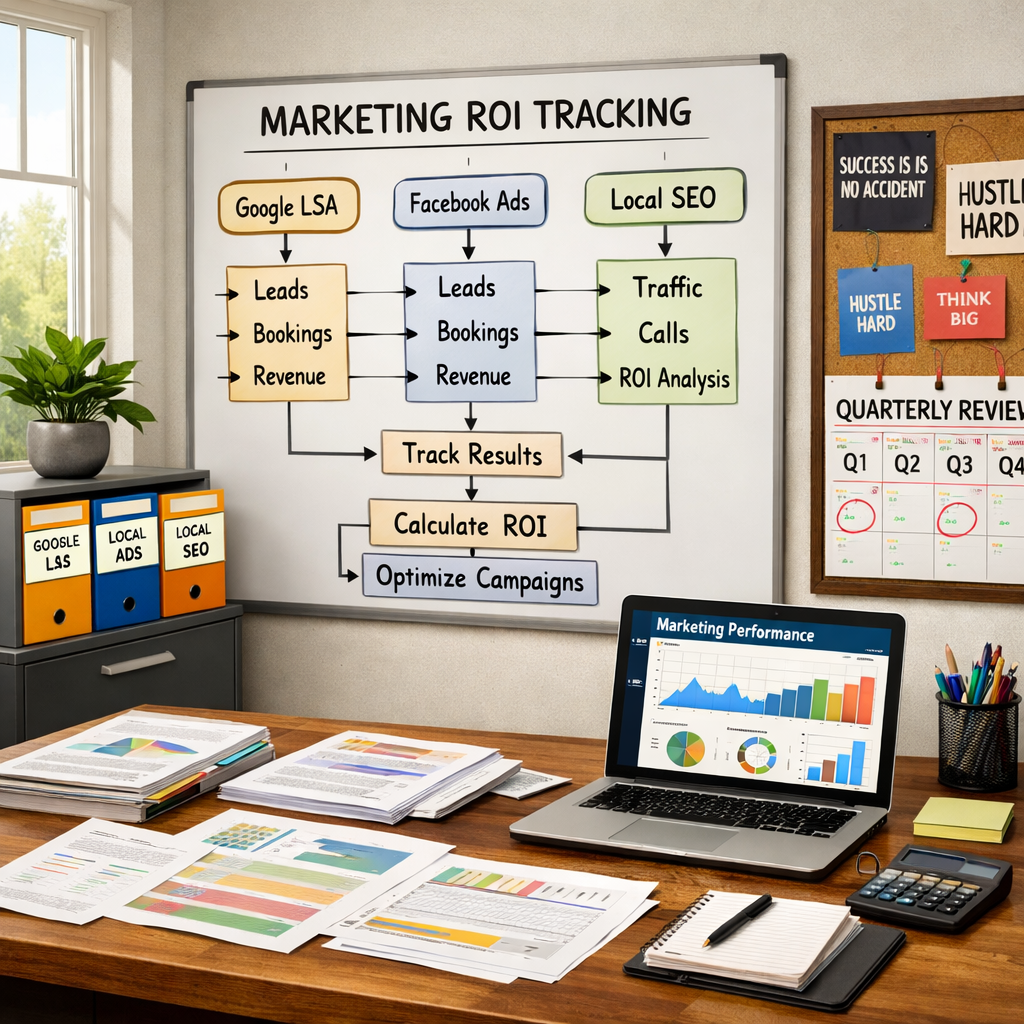
The 5 Bookkeeping Moves That Make Marketing ROI Visible
1. Marketing Subaccounts by Channel
Replace your single "Marketing" GL account with channel-level subaccounts. At minimum:
- Marketing – Google LSA
- Marketing – Google Search Ads
- Marketing – Facebook/Instagram Ads
- Marketing – Local SEO
- Marketing – Website / Hosting
- Marketing – Lead Aggregators (Angi, Thumbtack, etc.)
- Marketing – Direct Mail
- Marketing – Branding (truck wraps, signage, uniforms)
- Marketing – Sponsorships / Community
Every invoice gets coded to one of these. Every month, you see total spend by channel. Every quarter, you can compare channel spend to channel revenue and make decisions.
This single change — moving from one marketing account to nine — is the foundation of every other marketing ROI move. Without it, nothing else works.
2. Lead Source Tracking in the Field Service Platform
Every inbound lead (call, web form, LSA, referral) needs a lead-source field populated when the lead is booked. This is dispatch software work, not bookkeeping work — but the bookkeeping system needs to be able to pull that data and join it to revenue.
The data flow: lead source → booked job → invoiced revenue → attributable channel spend.
Without the lead source field populated on every job, you cannot attribute revenue to channel — and ROI calculation is impossible.
3. Cost-Per-Lead and Cost-Per-Acquired-Customer Reports by Channel
Monthly. By channel. With trend.
For LSA specifically in 2026:
- HVAC national average: $51 per lead
- HVAC major metros: $45–$80 per lead
- HVAC emergency summer: $100+ per lead
- Plumbing national average: $57 per lead
- Plumbing major metros: $35–$65 per lead
Compare your shop's actual cost-per-lead to these benchmarks. If you're meaningfully above, optimization opportunity. If you're meaningfully below, you may be missing volume your competitors are capturing.
Then take it one step deeper: cost per acquired customer, not just lead. At 44% LSA book rate, every booked customer costs roughly 2.3x the per-lead cost. At 60% close rate on quotes given, every closed customer costs roughly 3.8x the per-lead cost. The cost-per-customer number is what actually matters for ROI math.
4. Closed ROAS by Channel
Return on ad spend, calculated against closed revenue (not quoted, not booked — closed and invoiced).
Industry benchmark data for 2026:
- HVAC Google LSA: 9.55x closed ROAS in well-run campaigns
- Plumbing Google LSA: 6.85x closed ROAS, with $1,714 average ticket
- Local SEO: typically 10x+ when measured against attributable organic traffic
- Lead aggregators (Angi, Thumbtack): typically 2–4x — much lower than direct channels
- Direct mail: highly variable, often under 2x for general campaigns
These benchmarks are honest. Some channels are dramatically more efficient than others. The shops that don't track ROAS by channel are guaranteed to be over-investing in low-ROAS channels and under-investing in high-ROAS ones.
5. Lifetime Value Multiplier Layered on Top
The smartest move on top of straight ROAS: layer customer lifetime value on top of first-job revenue.
For a service customer acquired via LSA at $200 acquisition cost, generating $400 on the first call and likely returning for service over 7 years at $250/year average plus the eventual $9,000 replacement, true acquired-customer value is closer to $11,000. Effective acquisition cost ratio is 55x, not 2x.
This isn't fuzzy math — it's how the smartest competitors are thinking about marketing investment. Customer lifetime value, properly calculated and tracked in your books, turns every marketing channel ROI calculation into a much more compelling story (or a much harsher one, depending on the channel).
The Quarterly Marketing ROI Review
Once the bookkeeping infrastructure is in place, the operational discipline is a quarterly marketing ROI review. Sit down with the marketing channel report, walk it line by line, and make decisions.
Three questions on every channel:
1. What did we spend? Pulled directly from the segmented bookkeeping.
2. What did it produce? Closed revenue attributable to the channel via lead source tracking.
3. What's the decision? Three options: expand, optimize, or cut.
Channels that produce 5x+ ROAS with room to scale: expand. Channels producing 3–5x ROAS: optimize (better targeting, better landing page, better conversion process). Channels under 2x: cut, unless there's a strategic reason to keep them.
Done quarterly, this discipline alone typically generates 30–50% lift in marketing ROI within two quarters — without changing the total marketing budget. The contractors who run it are running the same dollars more effectively than the contractors who don't.
Why Local SEO and LSA Are Especially Valuable in 2026
Two trends make local SEO and LSA the highest-value channels for most home service contractors in 2026:
1. Homeowner search behavior is more high-intent than ever. 70% of homeowners book services online. Most service queries — "AC repair near me," "emergency plumber," "generator install" — happen in moments of immediate need with strong purchase intent.
2. LSA is dramatically cheaper than traditional Google Ads. $53 per lead average for LSA versus $104 blended Google Ads cost-per-lead — a 49% cost advantage. LSA also pays only for leads (not clicks), making cost predictable.
Combined, these mean that contractors with optimized Google Business Profiles, strong local SEO, and properly run LSA campaigns are capturing high-intent demand at lower cost per acquired customer than virtually any other channel. The bookkeeping work makes the math visible — and once it's visible, the decision to invest more aggressively becomes obvious.
The Recommended Budget Framework for 2026
Starting LSA budget benchmarks for residential contractors in 2026:
- HVAC: $1,500–$3,000/month to start; scale based on ROAS
- Plumbing: $2,000–$4,000/month to start; scale based on ROAS
- Electrical: $1,000–$2,500/month to start
These are starting points. The actual spend should be governed by ROAS, not by a fixed dollar amount. If LSA is producing 9x ROAS at $3,000/month and you have technician capacity to handle more volume, the answer is to scale spend — not cap it at "marketing budget."
The bookkeeping infrastructure is what makes this scaling decision possible. Without it, owners cap marketing at an arbitrary percentage of revenue, leave growth on the table, and watch competitors with better measurement systems pull ahead.
Why This Is What Bookkeeping for Home Service Contractors Should Be
Generic contractor bookkeeping setups have one "Advertising" line. They don't track marketing spend by channel, don't connect to lead source data, don't produce ROAS reports, and don't enable quarterly marketing ROI reviews. They produce a tax-compliant P&L and leave marketing measurement to vibes.
At PIVOTL, our bookkeeping and fractional accounting services are built specifically for HVAC, plumbing, electrical, and other home service contractors. We structure the books to enable real marketing ROI measurement — channel-level cost tracking, lead source attribution, ROAS reporting, lifetime value math. We're not accountants who learned the trades. We're home service operators who learned accounting.
The Bottom Line
Marketing is the largest discretionary spend line on most home service contractor P&Ls — and the one with the worst measurement infrastructure in the average shop.
The bookkeeping work to fix that is straightforward. Segment by channel. Track lead source. Calculate cost-per-customer and ROAS. Review quarterly. Make decisions.
Done well, this discipline typically generates 30–50% lift in marketing ROI in two quarters — without changing total budget. The contractors winning their markets in 2026 are running that playbook. The contractors who aren't are watching them.
Clarity creates confidence. In marketing, it also creates the growth budget your competitors don't realize they don't have.
Want help building marketing ROI tracking into your contractor bookkeeping? Schedule a 30-minute consultation with PIVOTL — we'll walk through your current marketing spend, set up the financial infrastructure to measure each channel, and identify where to expand, optimize, and cut.
PIVOTL provides bookkeeping and fractional accounting services built specifically for HVAC, plumbing, electrical, and other home service contractors. We translate the books into operational decisions — so you can run your business with the same clarity you bring to a job site. We're not accountants who learned the trades. We're home service operators who learned accounting.
Frequently Asked Questions
How much does Google LSA cost per lead for HVAC and plumbing contractors in 2026? HVAC averages $51 per lead nationally in early 2026 ($45–$80 in major metros, $100+ for emergency AC in peak summer). Plumbing averages $57 per lead nationally ($35–$65 in major metros). Both are roughly 49% cheaper than blended Google Ads CPL of $104.
What's a good ROAS benchmark for home service marketing channels? HVAC Google LSA delivers 9.55x closed ROAS in well-run campaigns. Plumbing LSA delivers 6.85x with $1,714 average ticket. Local SEO typically delivers 10x+ when measured against attributable organic traffic. Lead aggregators (Angi, Thumbtack) typically deliver 2–4x — meaningfully lower than direct channels.
How should contractor bookkeeping track marketing spend? Replace the single "Marketing" account with channel-level subaccounts: LSA, Google Search Ads, social ads, local SEO, website, lead aggregators, direct mail, branding, sponsorships. Pair with lead source tracking in your dispatch software so revenue can be attributed to channel. Run quarterly ROAS reviews and make expand/optimize/cut decisions per channel.
What marketing budget should a starting HVAC or plumbing contractor commit to LSA? Starting benchmarks: HVAC $1,500–$3,000/month, plumbing $2,000–$4,000/month, electrical $1,000–$2,500/month. These are starting points — actual spend should scale based on measured ROAS, not be capped by an arbitrary budget percentage.