
7 min read

Contractor Bookkeeping in Peak Season: The 13-Week Cash Flow Forecast Every HVAC, Plumbing, and Electrical Owner Needs in 2026

Contractor Bookkeeping in Peak Season: The 13-Week Cash Flow Forecast Every HVAC, Plumbing, and Electrical Owner Needs in 2026
13:25

If you run an HVAC, plumbing, or electrical contracting business, peak season is the most dangerous time of year for your bank account. Not because demand is low — because demand is high, and your bookkeeping isn't built to handle what high demand actually costs.


Most contractor bookkeeping systems are built for tax compliance, not operational decision-making. Your bookkeeper closes the month sometime in the second week of the next month, hands you a P&L, and the numbers tell you what happened thirty days ago. By the time you see a cash problem in the books, you're already living it.


That's the system that gets HVAC, plumbing, and electrical shops in trouble every summer. Payroll is up. Material costs are up. Seasonal hires are on the clock. Customers are still on net-30 (or net-60). And your bank balance starts moving in a direction you didn't expect — three weeks before the books will tell you why.


The fix is a 13-week rolling cash flow forecast — the single most valuable bookkeeping output a home service contractor can have during peak season, and the one most shops don't run. This is what it looks like, what it should track, and how to actually build it.

Why Standard Contractor Bookkeeping Fails in Peak Season

The average home service contracting business runs on cash-basis or modified-cash bookkeeping, with a monthly close that lags 2–3 weeks. That works fine in slow seasons. In peak season, it's actively dangerous.


Here's the gap. In peak season, three things happen at once:


  1. Outflows accelerate. Payroll grows because techs are on overtime. Material costs are paid weekly (or COD) to keep jobs moving. Seasonal hires get paychecks before they bring in revenue. Fleet costs rise with mileage.


  1. Inflows lag. Customers on terms don't pay faster just because you're busier. Net-30 is still net-30. Your A/R balance grows alongside your revenue — meaning the busier you look on the P&L, the tighter your cash position gets.


  1. The bookkeeping doesn't keep up. Monthly closes show last month's reality. Bank balance feels okay until it doesn't. Owners often realize they have a cash problem only when payroll is two weeks out and the math doesn't work.


The shops that get through peak season profitably are running a different system entirely. The book of record is still the monthly close. But the operating tool is the 13-week rolling cash flow forecast.

What a 13-Week Cash Flow Forecast Actually Is

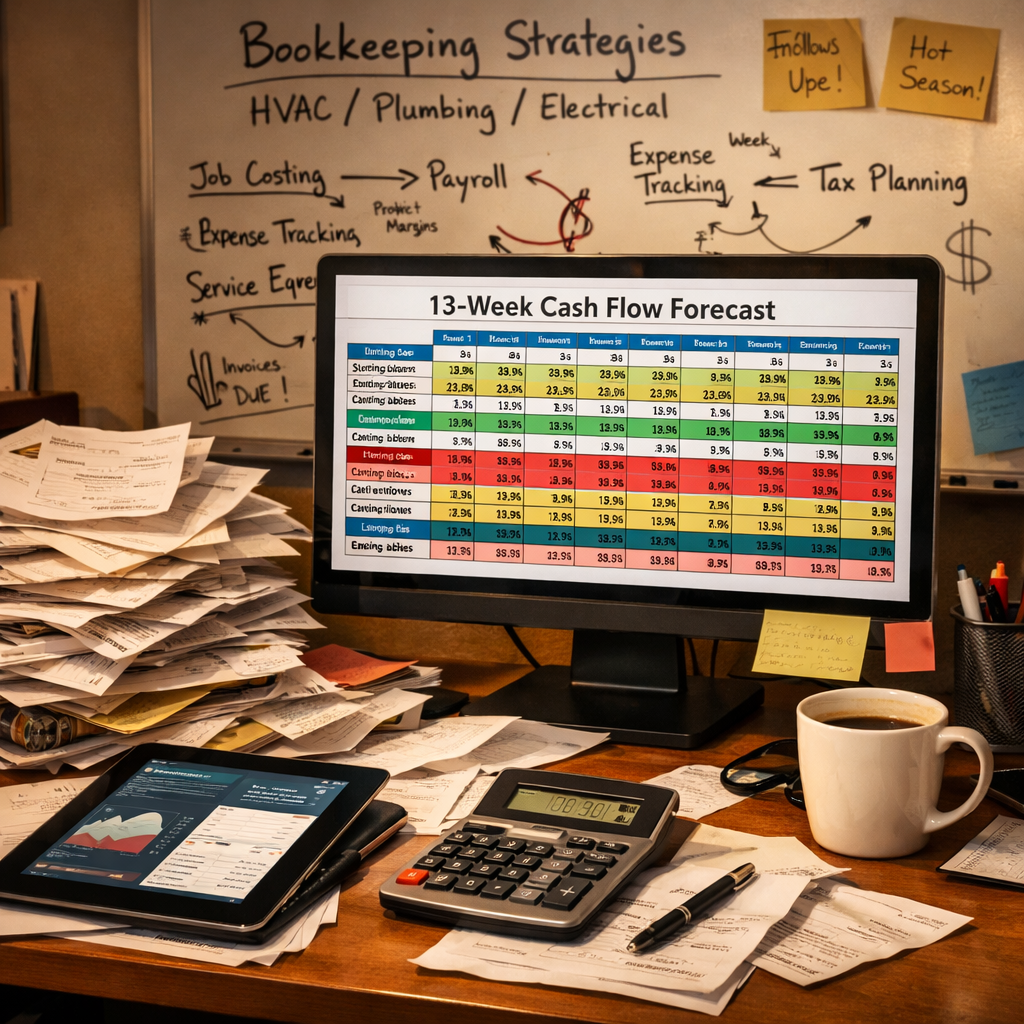
A 13-week rolling cash flow forecast is a working spreadsheet (or a function inside your accounting software) that shows, week by week, for the next 13 weeks:


  • Expected cash inflows from invoiced work
  • Expected cash inflows from work-in-progress that will invoice
  • Expected outflows for payroll
  • Expected outflows for materials and subcontractors
  • Expected outflows for overhead (rent, utilities, software, insurance, debt service)
  • Net cash position at the end of each week
  • Running bank balance


It's updated weekly. Every Monday morning, you roll the window forward, recalibrate based on actuals, and look at where the next 13 weeks are heading.


The point isn't precision. The point is visibility. If you can see a cash crunch six weeks out, you have six weeks to solve it. If you can't see it until the week it happens, you have hours. Those are very different conversations with a banker.

The Six Lines Your Contractor Cash Flow Forecast Must Track

For HVAC, plumbing, and electrical contractors specifically, a generic small-business cash forecast template won't cut it. Trades businesses have a specific cash rhythm — and your forecast has to reflect it.

Line 1: A/R Collections by Aging Bucket

Group your accounts receivable into current, 1–30 days past due, 31–60 days past due, and 60+ days past due. Forecast collections by applying historical collection rates to each bucket. A shop with $400K in current A/R and $80K in 31–60 day A/R will collect very different amounts of cash from those two buckets, and treating them as one number is how forecasts blow up.

Line 2: Work-in-Progress That Will Invoice

For installs and longer service jobs, track the jobs that have started but haven't invoiced yet. Estimate when each will close out and add the invoiced amount to the appropriate forecast week. This is where most contractor bookkeeping systems fall apart — they don't connect job status to cash forecasting at all.

Line 3: Weekly Payroll (Including Burdened Cost)

Payroll isn't just wages. It's payroll taxes, workers' comp accrual, benefits, and PTO funding. The "fully burdened" payroll cost runs 1.4–1.7x base wages for most trades. Your forecast needs to show the burdened cost on the week the cash actually leaves the bank — including the payroll tax deposit dates, which are not the same as paydays.

Line 4: Material and Subcontractor Outflows

Material payments to suppliers, often weekly or COD. Subcontractor payments on whatever terms you've negotiated. Track these by week based on planned job activity, not historical average. If next week has three big installs, the material spend that week will spike — your forecast needs to see that coming.

Line 5: Fixed Overhead

Rent, utilities, software subscriptions, insurance premiums, debt service, vehicle leases, internet, phones. These hit on specific dates each month. Plot them precisely on the forecast — not "$8,000 in May," but "$2,400 on the 1st, $3,200 on the 15th, $1,800 on the 25th, $600 on the 28th."

Line 6: Tax Reserves and Owner Distributions

The cash you set aside for estimated tax payments and the cash that leaves for owner draws. Both have to be on the forecast. Tax payment shocks are one of the most common preventable cash crunches in home service businesses.

What the Forecast Tells You That Your P&L Doesn't

A P&L tells you whether the business is profitable. It doesn't tell you whether the bank account is going to make it to Friday.


The 13-week forecast surfaces six things that monthly bookkeeping cannot:


Where the cash trough actually is. Most home service shops have a trough between Memorial Day and the Fourth of July — peak hiring and material spend before peak collection. The forecast shows it three to four weeks out, when you still have time to act.


Whether your line of credit needs to be drawn. And how much. And for how many weeks. Bankers love forecasts because the conversation becomes "I'm going to draw $80K on week 4 and pay it back by week 9" instead of "I need help, today, and I'm not sure why."


Whether you can afford the next hire. Adding a tech adds burdened payroll cost immediately and revenue with a lag. The forecast tells you whether your cash can absorb that lag, or whether you need to delay the hire by 4–6 weeks.


Whether you can pre-buy inventory. With tariffs driving material costs up and lead times extending, pre-buying ahead of need is a competitive advantage. But only if your forecast tells you the working capital is there to do it.


Whether a customer concentration problem is a cash flow problem. If one slow-paying customer is 18% of your A/R, the forecast makes that visible. So does the action plan to diversify.


Whether you can afford to take a draw. Owner distributions should come out of the forecast, not out of optimism. Shops that distribute based on bank balance, not cash forecast, are the ones who end up scrambling in October.

The Bookkeeping System That Powers It

A 13-week cash flow forecast only works if the bookkeeping behind it is structured for it. That means:


  • A chart of accounts segmented by trade line and revenue type
  • Weekly bookkeeping close discipline (not monthly)
  • A/R aging report that updates daily, not monthly
  • Job costing data that connects to the cash forecast (so work-in-progress shows up on time)
  • Bank reconciliation current to within 48 hours
  • Payroll tax obligations tracked separately and forecasted by deposit date
  • A clear owner draw policy with cash trigger thresholds


Most contractor bookkeeping setups aren't built this way. They're built to file taxes once a year and produce a year-end P&L. That's why most contractor owners can't run a forecast — the underlying data isn't structured to support one.


This is the part that separates a bookkeeping service from a bookkeeping system. The right bookkeeping system gives you the data; the system gives you decisions.

The Move Owners Should Make This Week

If you're an HVAC, plumbing, or electrical contractor heading into peak season without a 13-week cash flow forecast, the move this week is:


  1. Pull your A/R aging report and group by current / 1–30 / 31–60 / 60+
  2. List every payroll cycle for the next 13 weeks, with burdened cost
  3. List every recurring overhead expense with its payment date
  4. Map your planned jobs for the next 13 weeks and estimate when they'll invoice
  5. Build the simple version in a spreadsheet. Don't overengineer it. Get version 1 running in two hours, then refine.


Once you can see 13 weeks of cash position week by week, peak season stops being the most stressful time of year. It becomes the most profitable time of year.

Why This Is What Bookkeeping for Home Service Contractors Should Be

The reason most home service contractors don't get this level of bookkeeping is that it requires someone who understands both accounting AND the operational rhythm of a trades business. A generalist bookkeeper produces compliant books. A contractor-specialized bookkeeper produces decisions.


At PIVOTL, our bookkeeping and fractional accounting services are built specifically for HVAC, plumbing, electrical, and other home service contracting businesses. We're not accountants who learned the trades — we're home service operators who learned accounting. We run 13-week forecasts for our clients as a standard part of how we work, because in our experience, it's the single highest-impact bookkeeping deliverable a home service shop can have.

The Bottom Line

Peak season exposes whether your contractor bookkeeping is built for the business you actually run. If the only number you see weekly is your bank balance, you're not running a system — you're hoping.


The 13-week cash flow forecast turns peak season from a survival exercise into a planning exercise. It's the difference between owning your summer and being owned by it.


Clarity creates confidence. In peak season, it also creates cash.


Want help building a 13-week cash flow forecast for your contracting business? Schedule a 30-minute bookkeeping consultation with PIVOTL — we'll walk through your current bookkeeping setup, show you what's missing, and outline what it would take to run weekly forecasts with confidence.


PIVOTL provides bookkeeping and fractional accounting services built specifically for HVAC, plumbing, electrical, and other home service contractors. We translate the books into operational decisions — so you can run your business with the same clarity you bring to a job site. We're not accountants who learned the trades. We're home service operators who learned accounting.


Frequently Asked Questions

What kind of bookkeeping do HVAC, plumbing, and electrical contractors need? Home service contractors need bookkeeping built around job costing, trade-line P&L, weekly close discipline, and cash flow forecasting — not the generic small-business bookkeeping most accountants offer. The chart of accounts, KPI tracking, and reporting cadence all need to reflect how contracting businesses actually generate and consume cash.


What is a 13-week cash flow forecast? A 13-week cash flow forecast is a weekly-updated projection of every cash inflow and outflow over the next 13 weeks. For contractors, it should include A/R collections by aging bucket, work-in-progress invoicing, burdened payroll, material and subcontractor payments, fixed overhead, and tax/owner-draw outflows. Updated weekly, it gives owners 13 weeks of forward visibility into bank position.


How often should a contracting business close its books? Weekly is the standard for any home service contractor running on tight margins or experiencing growth. Monthly close is too slow to catch cash flow problems before they become urgent. Weekly bookkeeping also enables real-time job costing, weekly margin tracking by trade line, and a continuously updated cash forecast.


What's the difference between a bookkeeper and a fractional accountant for contractors? A bookkeeper records transactions and produces financial statements. A fractional accountant (or fractional CFO) builds and runs financial systems, interprets the numbers in business terms, and drives strategic decisions. Most home service contractors benefit from a combined offering — bookkeeping plus financial leadership — that costs less than a full-time controller while delivering far more impact.